
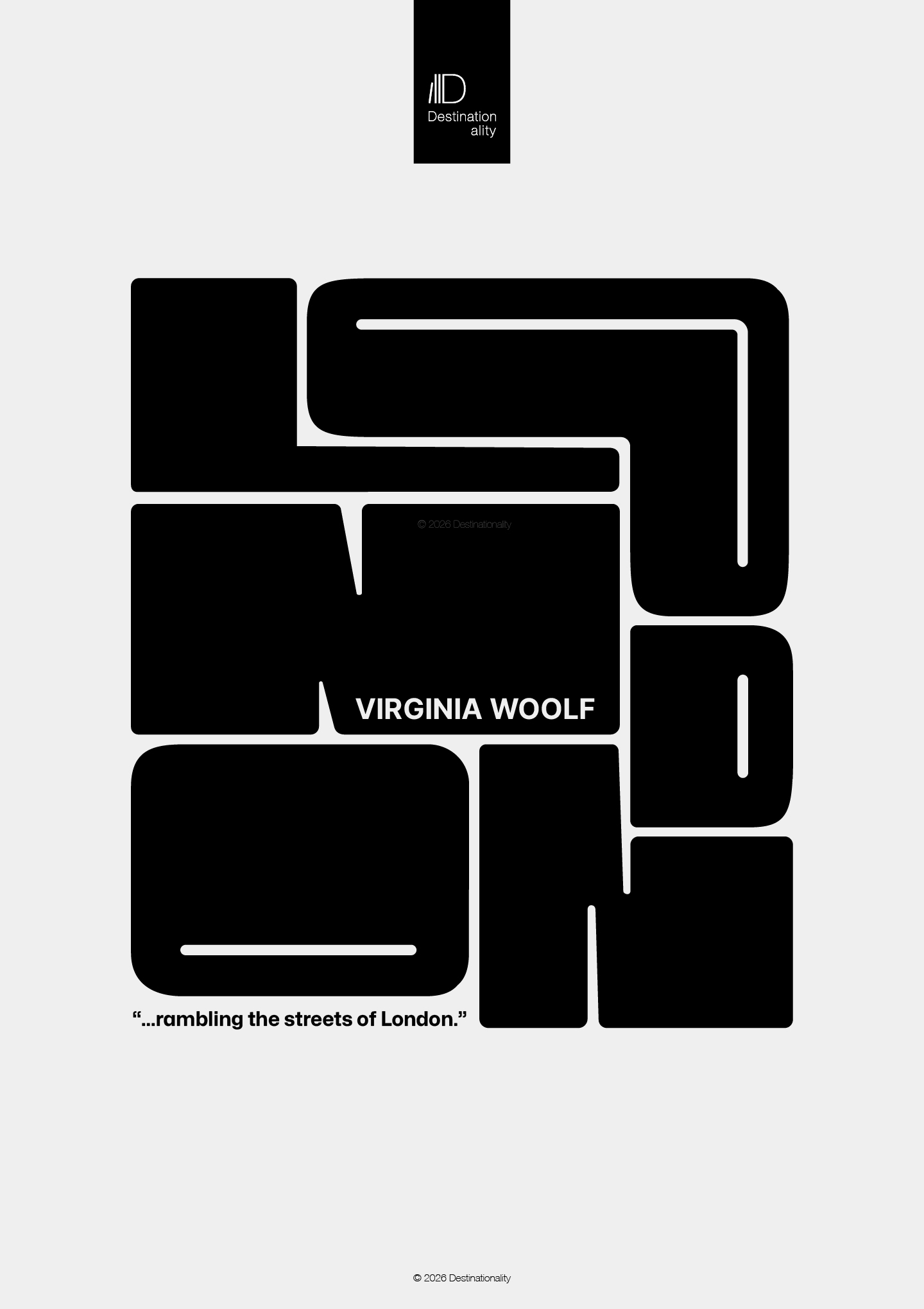
 Berkay Taş for Destinationality
No one perhaps has ever felt passionately towards a lead pencil. But there are circumstances in which it can become supremely desirable to possess one; moments when we are set upon having an object, an excuse for walking half across London between tea and dinner. …and getting up we say: “Really I must buy a pencil,” as if under cover of this excuse we could indulge safely in the greatest pleasure of town life in winter—rambling the streets of London.
The hour should be the evening and the season winter, for in winter the champagne brightness of the air and the sociability of the streets are grateful. We are not then taunted as in the summer by the longing for shade and solitude and sweet airs from the hayfields. The evening hour, too, gives us the irresponsibility which darkness and lamplight bestow. We are no longer quite ourselves. As we step out of the house on a fine evening between four and six, we shed the self our friends know us by and become part of that vast republican army of anonymous trampers, whose society is so agreeable after the solitude of one’s own room.
…
How beautiful a London street is then, with its islands of light, and its long groves of darkness, and on one side of it perhaps some tree–sprinkled, grass–grown space where night is folding herself to sleep naturally and, as one passes the iron railing, one hears those little cracklings and stirrings of leaf and twig which seem to suppose the silence of fields all round them, an owl hooting, and far away the rattle of a train in the valley. But this is London, we are reminded; high among the bare trees are hung oblong frames of reddish yellow light—windows; there are points of brilliance burning steadily like low stars—lamps; this empty ground, which holds the country
in it and its peace, is only a London square, set about by offices and houses where at this hour fierce lights burn over maps, over documents, over desks where clerks sit turning with wetted forefinger the files of endless correspondences; or more suffusedly the firelight wavers and the lamplight falls upon the privacy of some drawing–room, its easy chairs, its papers, its china, its inlaid table, and the figure of a woman, accurately measuring out the precise number of spoons of tea which——She looks at the door as if she heard a ring downstairs and somebody asking, is
she in?
…
Let us dally a little longer, be content still with surfaces only—the glossy brilliance of the motor omnibuses; …the blue and red bunches of flowers burning so bravely through the plate glass of the florists’ windows.
…
Passing, glimpsing, everything seems accidentally but miraculously sprinkled with beauty, as if the tide of trade which deposits its burden so punctually and prosaically upon the shores of Oxford Street had this night cast up nothing but treasure. …let us indulge ourselves at the antique jewelers, among the trays of rings and the hanging necklaces. Let us choose those pearls, for example, and then imagine how, if we put them on, life would be changed. It becomes instantly between two and three in the morning; the lamps are burning very white in the deserted streets of Mayfair. Only motor–cars are abroad at this hour, and one has a sense of emptiness, of airiness, of secluded gaiety. Wearing pearls, wearing silk, one steps out on to a balcony which overlooks the gardens of sleeping Mayfair. There are a few lights in the bedrooms of great peers returned from Court, of silk–stockinged footmen, of dowagers who have pressed the hands of statesmen. A cat creeps along the garden wall. Love–making is going on sibilantly, seductively in the darker places of the room behind thick green curtains. Strolling sedately as if he were promenading a terrace beneath which the shires and counties of England lie sun–bathed, the aged Prime Minister recounts to Lady So–and–So with the curls and the emeralds the true history of some great crisis in the affairs of the land. We seem to be riding on the top of the highest mast of the tallest ship; …as we stand on the balcony watching the moonlit cat creep along Princess Mary’s garden wall.
…
…in the street outside, one catches a word in passing and from a chance phrase fabricates a lifetime. It is about a woman called Kate that they are talking, how “I said to her quite straight last night . . . if you don’t think I’m worth a penny stamp, I said . . .” But who Kate is, and to what crisis in their friendship that penny stamp refers, we shall never know; for Kate sinks under the warmth of their volubility; and here, at the street corner, another page of the volume of life is laid open by the sight of two men consulting under the lamp–post. They are spelling out the latest wire from Newmarket in the stop press news. Do they think, then, that fortune will ever convert their rags into fur and broadcloth, sling them with watch–chains, and plant diamond pins where there is now a ragged open shirt? But the main stream of walkers at this hour sweeps too fast to let us ask such questions. They are wrapt, in this short passage from work to home, in some narcotic dream, now that they are free from the desk, and have the fresh air on their cheeks.
…
As it is, we must turn, we must cross the Strand again, we must find a shop where, even at this hour, they will be ready to sell us a pencil.
…
In these minutes in which a ghost has been sought for, a quarrel composed, and a pencil bought, the streets had become completely empty. Life had withdrawn to the top floor, and lamps were lit. The pavement was dry and hard; the road was of hammered silver. Walking home through the desolation one could tell oneself the story of the dwarf, of the blind men, of the party in the Mayfair mansion, of the quarrel in the stationer’s shop. Into each of these lives one could penetrate a little way, far enough to give oneself the illusion that one is not tethered to a single mind, but can put on briefly for a few minutes the bodies and minds of others. One could become a washerwoman, a publican, a street singer. And what greater delight and wonder can there be than to leave the straight lines of personality and deviate into those footpaths that lead beneath brambles and thick tree trunks into the heart of the forest where live those wild beasts, our fellow men?
That is true: to escape is the greatest of pleasures; street haunting in winter the greatest of adventures. Still as we approach our own doorstep again, it is comforting to feel the old possessions, the old prejudices, fold us round; and the self, which has been blown about at so many street corners, which has battered like a moth at the flame of so many inaccessible lanterns, sheltered and enclosed. Here again is the usual door; here the chair turned as we left it and the china bowl and the brown ring on the carpet. And here—let us examine it tenderly, let us touch it with reverence—is the only spoil we have retrieved from all the treasures of the city, a lead pencil.