
 Destinationality
“Now when I was a little chap I had a passion for maps. I would look for hours at South America, or Africa, or Australia, and lose myself in all the glories of exploration. At that time there were many blank spaces on the earth, and when I saw one that looked particularly inviting on a map (but they all look that) I would put my finger on it and say, ‘When I grow up I will go there.’ …But there was one yet—the biggest, the most blank, so to speak—that I had a hankering after.
“True, by this time it was not a blank space any more. It had got filled since my boyhood with rivers and lakes and names. It had ceased to be a blank space of delightful mystery—a white patch for a boy to dream gloriously over. It had become a place of darkness. But there was in it one river especially, a mighty big river, that you could see on the map, resembling an immense snake uncoiled, with its head in the sea, its body at rest curving afar over a vast country, and its tail lost in the depths of the land. And as I looked at the map of it in a shop-window, it fascinated me… I thought to myself… Why shouldn’t I try…? I… could not shake off the idea. The snake had charmed me.
“…I felt somehow I must get there by hook or by crook.
…
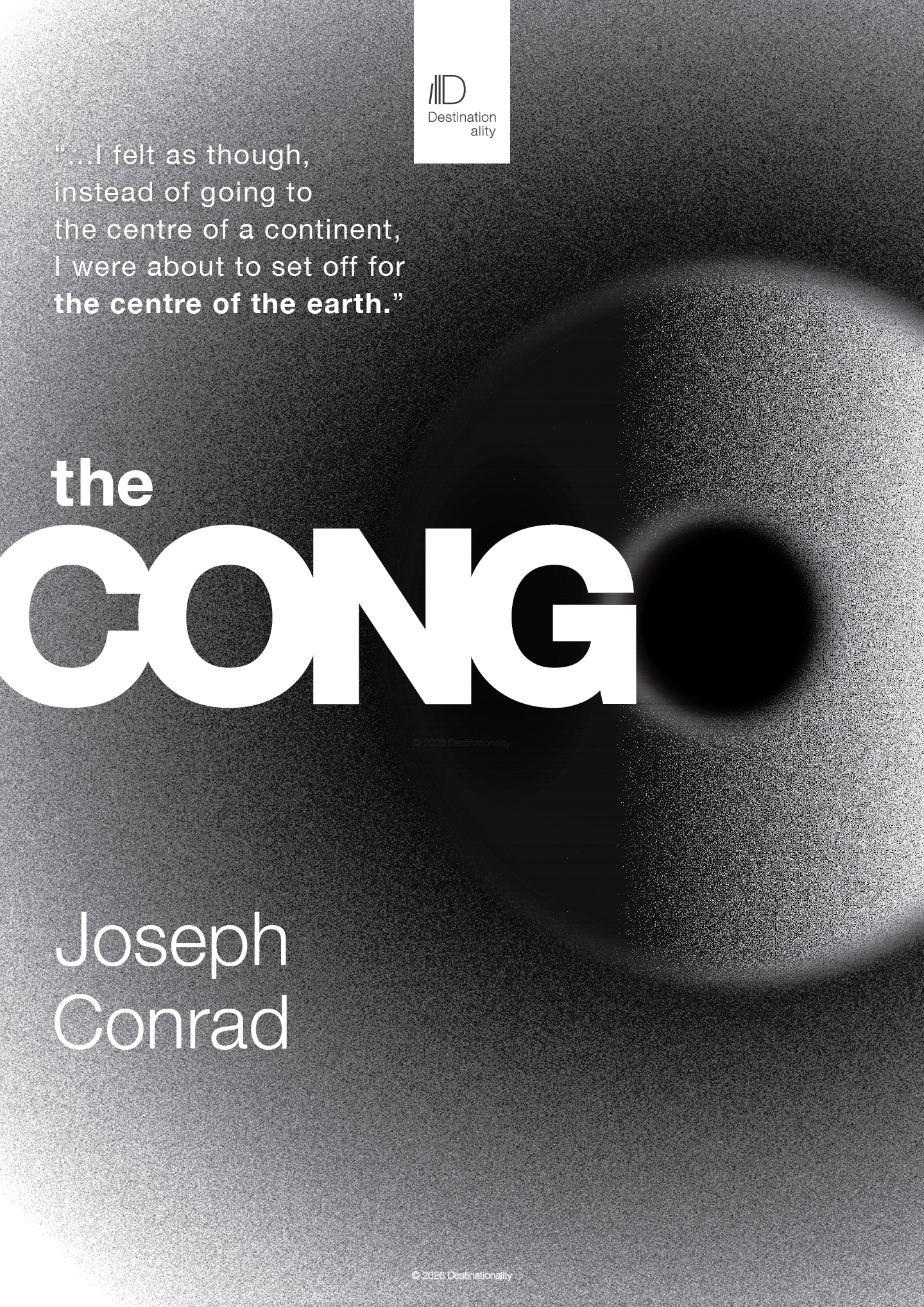
“…and I left. …why—a queer feeling came to me… Odd thing that I, who used to clear out for any part of the world at twenty-four hours’ notice, with less thought than most men give to the crossing of a street, had a moment—I won’t say of hesitation, but of startled pause, before this commonplace affair. The best way I can explain it to you is by saying that, for a second or two, I felt as though, instead of going to the centre of a continent, I were about to set off for the centre of the earth.
“I left in a French steamer… I watched the coast. Watching a coast as it slips by the ship is like thinking about an enigma. There it is before you—smiling, frowning, inviting, grand, mean, insipid, or savage, and always mute with an air of whispering, ‘Come and find out.’ This one was almost featureless, as if still in the making, with an aspect of monotonous grimness. The edge of a colossal jungle, so dark-green as to be almost black, fringed with white surf, ran straight, like a ruled line, far, far away along a blue sea whose glitter was blurred by a creeping mist. The sun was fierce, the land seemed to glisten and drip with steam. Here and there greyish-whitish specks showed up clustered inside the white surf, with a flag flying above them perhaps. Settlements some centuries old, and still no bigger than pinheads on the untouched expanse of their background.
…
“…I went on to the riverside… Beyond the fence the forest stood up spectrally in the moonlight, and through that dim stir, through the faint sounds of that lamentable courtyard, the silence of the land went home to one’s very heart—its mystery, its greatness, the amazing reality of its concealed life.
“…The smell of mud, of primeval mud… was in my nostrils, the high stillness of primeval forest was before my eyes; there were shiny patches on the black creek. The moon had spread over everything a thin layer of silver—over the rank grass, over the mud, upon the wall of matted vegetation standing higher than the wall of a temple, over the great river I could see through a sombre gap glittering, glittering, as it flowed broadly by without a murmur. All this was great, expectant, mute… I wondered whether the stillness on the face of the immensity looking at us… were meant as an appeal or as a menace. What were we who had strayed in here? Could we handle that dumb thing, or would it handle us? I felt how big, how confoundedly big, was that thing that couldn’t talk, and perhaps was deaf as well. What was in there?
…
“The great wall of vegetation, an exuberant and entangled mass of trunks, branches, leaves, boughs, festoons, motionless in the moonlight, was like a rioting invasion of soundless life, a rolling wave of plants, piled up, crested, ready to topple over the creek, to sweep every little man of us out of his little existence. And it moved not.
…
“…the… Expedition went into the patient wilderness, that closed upon it as the sea closes over a diver.
“Going up that river was like traveling back to the earliest beginnings of the world, when vegetation rioted on the earth and the big trees were kings. An empty stream, a great silence, an impenetrable forest. The air was warm, thick, heavy, sluggish. There was no joy in the brilliance of sunshine. The long stretches of the waterway ran on, deserted, into the gloom of overshadowed distances. On silvery sand-banks hippos and alligators sunned themselves side by side. The broadening waters flowed through a mob of wooded islands; you lost your way on that river as you would in a desert, and butted all day long against shoals, trying to find the channel, till you thought yourself bewitched and cut off for ever from everything you had known once—somewhere—far away—in another existence perhaps. There were moments when one’s past came back to one, as it will sometimes when you have not a moment to spare for yourself; but it came in the shape of an unrestful and noisy dream, remembered with wonder amongst the overwhelming realities of this strange world of plants, and water, and silence. And this stillness of life did not in the least resemble a peace. It was the stillness of an implacable force brooding over an inscrutable intention. It looked at you with a vengeful aspect.
…
“…and on we went again into the silence, along empty reaches, round the still bends, between the high walls of our winding way… Trees, trees, millions of trees, massive, immense, running up high… The reaches opened before us and closed behind, as if the forest had stepped leisurely across the water to bar the way for our return. We penetrated deeper and deeper into the heart of darkness. It was very quiet there. At night sometimes the roll of drums behind the curtain of trees would run up the river and remain sustained faintly, as if hovering in the air high over our heads, till the first break of day. Whether it meant war, peace, or prayer we could not tell. The dawns were heralded by the descent of a chill stillness; the wood-cutters slept, their fires burned low; the snapping of a twig would make you start. We were
wanderers on a prehistoric earth, on an earth that wore the aspect of an unknown planet. We could have fancied ourselves the first of men taking possession of an accursed inheritance, to be subdued at the cost of profound anguish and of excessive toil. But suddenly, as we struggled round a bend, there would be a glimpse of rush walls, of peaked grass-roofs, a burst of yells, a whirl of black limbs, a mass of hands clapping, of feet stamping, of bodies swaying, of eyes rolling, under the droop of heavy and motionless foliage. …on the edge of a black and incomprehensible frenzy. The prehistoric man was cursing us, praying to us, welcoming us—who could tell? We were cut off from the comprehension of our surroundings; we glided past like phantoms…”